


Bubble Busters PvP
PixelPie Games
Bubble Busters PvP is the kind of casual game I open when I want a quick burst of competition without committing to a long story campaign or a complicated strategy session. It puts bubble shooting into matches against real people, then adds game modes and RPG-style upgrades around that familiar idea. After spending time with it, I found the appeal easy to understand: the basic action is immediately readable, but the competitive layer gives each round more purpose than simply clearing colored bubbles.
Developed by PixelPie Games, the game is free to start and suitable for Everyone. It has reached over 500 thousand installs and holds a 4.7 average from around 20 thousand ratings, which suggests that its straightforward multiplayer formula has connected with a substantial audience. I would describe it as a casual competitive game rather than a relaxing puzzle title. Even when a match is short, playing against another person gives every shot a little more pressure.
The current version is 1.25.48, and the game is available for devices running Android 10 or later. That operating-system requirement is worth checking before downloading, especially if you are using an older phone or tablet. The game itself is free, although optional in-app purchases range from $0.99 to $99.99 per item. That pricing range makes it important to decide early whether you are comfortable treating purchases as an occasional convenience rather than part of your normal play routine.
How Bubble Busters PvP feels in everyday play
Quick matches with more tension than a standard bubble shooter
The familiar bubble-shooter controls make the opening moments easy. You aim, choose your angle, and try to create useful matches instead of firing randomly. What changes the mood is the presence of a real opponent. A move that would feel merely inefficient in a solo puzzle can become costly when another player is building momentum at the same time.
I especially like that the game does not need a long tutorial to explain its central idea. Someone who has played a traditional bubble shooter can understand the foundation almost immediately. The extra modes and RPG upgrades are where the longer-term interest comes from, giving you reasons to think about progression rather than treating every round as an isolated puzzle.
Related News

Threads in Real Life: Who Should Join, Lurk, or Leave

How SHEIN Turned Shopping Into an Endless Content Feed

How to Make Fortnite Feel Smarter on Mobile

Should You Switch to Microsoft Outlook on Mobile?

Why Gallery Keeps Pulling Users Back

X Review: Why Its Network Still Matters
That combination makes it a good fit for short breaks. I can imagine playing during a commute, while waiting for an appointment, or after finishing a small task at home. It is not the game I would choose when I want a quiet, uninterrupted puzzle experience, because the competitive format encourages me to react to the opponent instead of calmly planning several moves ahead.
What speed feels like during a normal session
From a player’s point of view, the game is built around a quick rhythm: enter a match, make decisions under pressure, and move on to the next activity. The individual actions are simple enough that the mental load comes from timing and positioning rather than from learning a large control scheme. This makes the game feel accessible, but it also means experienced players may quickly start looking for better tactical habits.
One useful approach is to stop treating every available match as an opportunity to shoot immediately. I found it more satisfying to pause briefly and inspect the board for a shot that creates a larger follow-up opportunity. In a competitive setting, the fastest visible move is not always the fastest route to an advantage. A slightly slower decision can prevent a weak turn and leave a better arrangement for the next shot.
Gallery
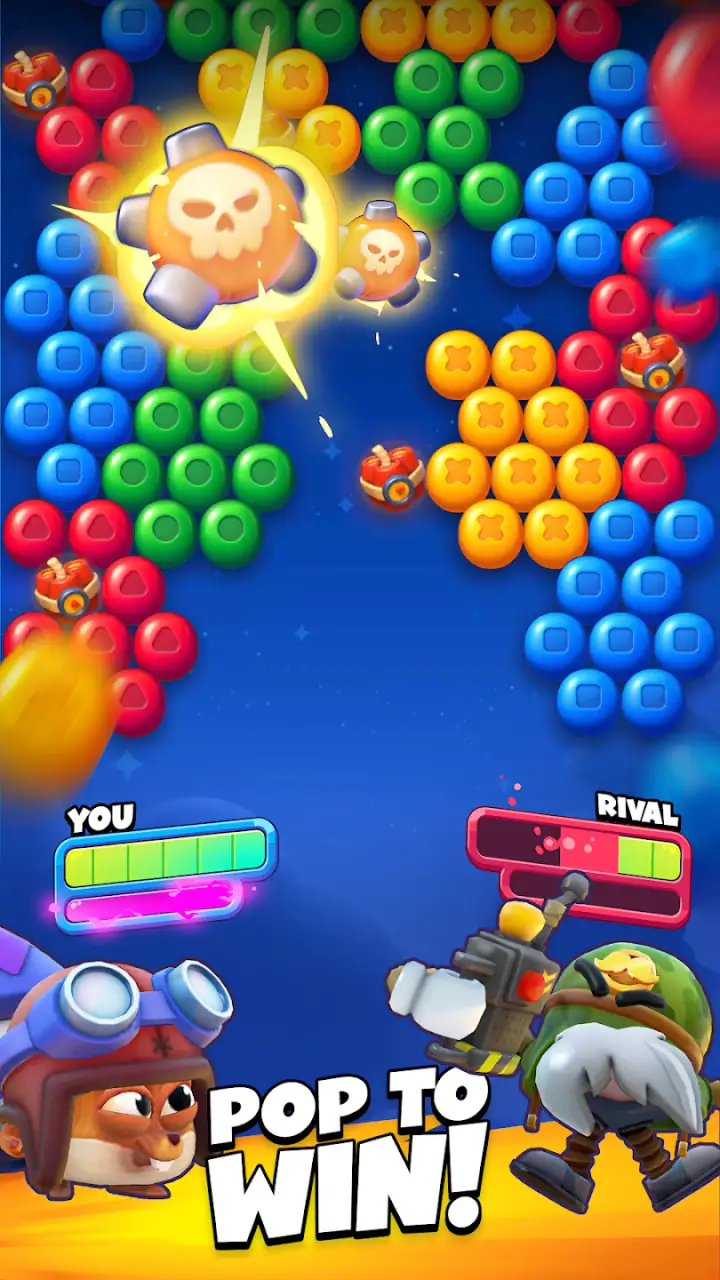
The game’s speed expectations also depend on what you want from it. If you want an instant, low-effort distraction, the familiar format works well. If you expect the depth of a large competitive strategy game, the bubble-shooter foundation may feel narrower. The RPG upgrades add another layer, but they do not turn the experience into a full role-playing adventure. I see them as a way to give progression more weight, not as a replacement for the match itself.
Handling busy moments and repeated play
The most demanding moments are not necessarily the opening shots. They arrive when the board becomes crowded, the opponent is making progress, and a poor angle can remove several possible options. That is when I notice the difference between casual tapping and deliberate play. I try to identify which colors or clusters are limiting my future choices before committing to a shot.
For longer sessions, the main strain is likely to come from repetition rather than from complex controls. Bubble shooters have an inherently focused loop, and the competitive element can encourage “one more match” behavior. I recommend setting a natural stopping point, particularly if you are playing during a break and do not want a short session to expand unexpectedly.
A practical routine is to use the first few matches of a session as observation rather than as a test of your overall skill. Pay attention to how aggressively you are spending shots, how often you are choosing a safe clear over a risky setup, and whether the upgrade path is supporting the way you actually play. This is more useful than changing direction after every loss.
The upgrade system also creates a trade-off. Progression can make continued play feel meaningful, but it may encourage players to focus on improving their account rather than improving their decisions. I prefer to treat upgrades as support for a style I already understand. If you buy or pursue improvements without knowing what problem they solve, the added layer can become distracting instead of helpful.
Reliability and what to expect from a multiplayer game
Because this is a PvP game, reliability matters in a different way than it does in a purely offline puzzle. The quality of a session depends not only on the board and controls, but also on whether the match proceeds smoothly enough for decisions to feel fair. A multiplayer game can be frustrating when the result seems disconnected from the player’s choices, so I judge it by how consistently the basic match flow supports those choices.
I would not recommend starting an important match when your connection or attention is already unreliable. Even a simple bubble shot deserves a moment of concentration when another person is involved. If you are playing in a noisy environment, a solo puzzle may be a better choice because it is easier to pause mentally and return without feeling that you have lost the thread of the game.
Recovery is another consideration. The short-session structure makes it easier to return after a break than it would be in a long campaign. You do not need to remember a complicated plot or reconstruct a large map. However, returning after a disappointing loss can tempt you to chase the result immediately. I have found it better to review what went wrong—an impatient shot, a poor setup, or an upgrade choice—before beginning another match.
The game’s broad audience rating is helpful for families and younger players who want a colorful casual contest, but adults should still remember that multiplayer competition changes the tone. “Everyone” describes the content rating, not whether every player will enjoy competitive pressure. Someone looking for a completely peaceful game may prefer a conventional solo bubble shooter instead.
Device limits, storage expectations, and practical comfort
The stated minimum of Android 10 gives the clearest device constraint. Owners of older hardware should check compatibility before planning around the game. For supported devices, I would still pay attention to practical comfort: screen size, touch accuracy, battery condition, and how easily you can hold the device while aiming.
A larger display can make aiming feel more comfortable, especially when you are trying to judge a narrow angle or select a small target area. A compact phone is more convenient for brief sessions, but it may make the board feel visually tighter. That is not a reason to avoid the game; it is simply a reason to adjust expectations and avoid playing rushed matches when your finger is covering part of the action.
I also would not assume that a supported operating system automatically means identical comfort on every device. Hardware age, screen responsiveness, and background activity can all affect how a game feels, even when the software technically runs. If your phone is already struggling with other games, keep sessions shorter and close unnecessary apps before playing. Those are sensible habits for any interactive title, but they matter more when a precise shot determines the result.
Resource demands are best considered from the game’s format rather than from invented performance figures. It combines real-time competition, multiple modes, and progression, so it is more involved than a basic offline bubble app. At the same time, the core interaction remains visually focused and uncomplicated. I would place it in the middle ground: not a sprawling graphics-heavy game, but not something I would choose solely because I wanted the lightest possible app on an older device.
Free access, purchases, and progression choices
The free entry point is one of the strongest reasons to try it. You can discover whether the competitive bubble-shooter format suits you without paying first. That matters because the game’s appeal depends heavily on your response to PvP pressure. If you prefer solo puzzles, no amount of free access will change the central experience enough to make it the right match.
Optional purchases start at $0.99 and extend to $99.99 per item. I would approach that range carefully. The most comfortable way to play is to decide on a personal limit before browsing purchase options, rather than making a decision immediately after a loss or during a progression bottleneck. Free-to-play games are easier to enjoy when spending remains a deliberate choice instead of a reaction to frustration.
My advice is to learn the basic match loop before paying for anything. Use early play to discover whether you enjoy aiming under pressure, whether you like the available modes, and whether the RPG layer adds motivation or simply feels like extra management. If the game is fun without spending, an occasional purchase can remain optional. If it is not fun at the free level, buying progress is unlikely to fix the underlying mismatch.
Who will enjoy it, and who should choose something else
I would recommend Bubble Busters PvP to players who already enjoy casual puzzle games but want more unpredictability than a fixed solo board provides. It is also a good choice for someone who likes short competitive sessions, visible progression, and learning through repeated matches. The controls are approachable, so it does not demand a long adjustment period before you can understand what you are doing.
It suits a friend who says, “I want something quick, but I still want a reason to come back.” The combination of multiplayer matches, different game modes, and upgrades gives each session more context than a disposable time-killer. The strongest audience is probably the player who enjoys improving small decisions: choosing a better angle, preserving a useful color, or resisting the urge to fire too quickly.
I would point a different player toward another type of game. If you want a story, exploration, or deep character customization, this is not a substitute for a role-playing game. If you want a calm experience with no opponent and no purchase decisions, a traditional offline bubble shooter will likely be more comfortable. And if competitive losses quickly spoil your mood, the PvP structure may outweigh the convenience of short matches.
Three habits that make the game more enjoyable
First, I recommend separating board improvement from immediate clearing. A shot that removes bubbles now may leave an awkward arrangement afterward, while a less dramatic shot can open a stronger route. This is a small change in thinking, but it prevents the game from becoming a reflex exercise where every turn is judged only by its immediate result.
Second, use the upgrade system with a specific purpose. Before choosing an improvement, ask whether it helps your usual weakness. If you often lose because you rush, an upgrade will not replace patience. If you consistently struggle to create follow-up opportunities, focus on understanding your setup decisions before assuming progression alone will solve the problem.
Third, treat match selection as part of performance management. Play when you can give the board your attention, and take a break after a run of careless decisions. This is not about taking a casual game too seriously; it is about recognizing that a competitive format feels much better when you are alert enough to make choices intentionally.
My performance verdict after using it
Bubble Busters PvP succeeds because it does not overcomplicate its central idea. The familiar bubble-shooter action gives new players an accessible starting point, while real opponents and RPG upgrades provide reasons to keep refining the way you play. Its strongest performance quality is the sense of immediacy: it is easy to understand what to do, yet the competitive context makes simple actions matter.
The limitations are equally clear. The experience is more demanding emotionally than a solo puzzle, and the repeated competitive loop will not suit everyone. The broad age rating does not remove the need for sensible spending boundaries, particularly with purchases reaching $99.99 per item. Device compatibility also begins at Android 10, so older phones are not the safest assumption.
Overall, I think this is a worthwhile free casual game for players who want quick PvP rounds with a little progression attached. I would install it for a short, repeatable challenge rather than for a large adventure or a technically ambitious showcase. My main recommendation is to try the free experience first, play deliberately, and decide whether the competitive rhythm—not just the bubble shooting—keeps you coming back.
FAQs for Bubble Busters PvP
What is Bubble Busters PvP and how does the gameplay work?
Bubble Busters PvP is a competitive bubble-shooting game focused on real-time or asynchronous player-versus-player matches, depending on the available mode. You aim, match bubbles by color, clear obstacles, and create combos while trying to finish objectives faster or score higher than your opponent. Matches are generally easy to understand, but later levels require careful planning and quick decisions.
Does Bubble Busters PvP require an internet connection?
An internet connection is usually important for the main competitive features, including matchmaking, player rankings, online events, account synchronization, and leaderboard updates. Some menus or solo content may remain accessible when you are offline, but availability can vary by version and device. For the smoothest experience, especially during PvP matches, use a stable Wi-Fi or mobile-data connection.
Is Bubble Busters PvP free to download and play?
Bubble Busters PvP can generally be downloaded for free, allowing players to begin playing without an upfront purchase. However, free-to-play games commonly include optional in-app purchases for boosters, extra attempts, cosmetic items, currencies, or faster progression. These purchases are not necessarily required to enjoy the game, but competitive players should review the store and spending settings before playing.
Is Bubble Busters PvP suitable for children?
The game is simple enough for many younger players to understand, thanks to its colorful visuals and straightforward bubble-matching mechanics. Nevertheless, parents should check the official age rating, advertising content, chat or social functions, and in-app purchase options before allowing children to play. If a child uses the game, parental controls and purchase restrictions are recommended.
What devices are compatible with Bubble Busters PvP?
Compatibility depends on the specific Android or iOS version available in your region and the requirements listed on the official store page. Most recent smartphones and tablets should handle a casual bubble game, although older devices may experience slower loading, reduced performance, or limited support after updates. Check the required operating-system version and available storage before downloading.
Pros
- Quick PvP matches are ideal for short gaming sessions.
- Simple bubble-shooting controls are easy for new players to learn.
- Competitive battles provide a clear reason to keep improving.
- Colorful visuals and playful effects make matches enjoyable.
- Different strategies can make each opponent feel challenging.
Cons
- Match outcomes may depend heavily on connection quality.
- Repeated battles can feel similar after extended play.
- Progress may become slower without regular play or upgrades.
- Competitive pressure may not appeal to casual players.
- Some features or resources may be limited by in-app purchases.


